English training for hotel staff in Fort Lauderdale
Fort Lauderdale pairs a beachfront hotel strip with Port Everglades, one of the busiest cruise ports in the world, and a marine industry that fills rooms well outside the traditional leisure season.
Inglés Hotelero trains the Spanish-speaking staff of hotels in Fort Lauderdale, Florida to work in English. Every employee takes a free CEFR placement test (A1 to B2), then practices five minutes a day on a lean web-based platform using the English their own job actually requires. Front desk, bellhop and restaurant are separate modules. Pricing is per property, not per employee, and starts at $150 USD a month. Human resources sees each person's level and progress on a dashboard.
In Fort Lauderdale, your team's English shows up in every review.
Beachfront resorts along A1A serve leisure and cruise pre-stays, while properties near the convention center and the airport handle groups and turnaround traffic. Port Everglades produces enormous same-day arrival and departure volume on embarkation days, and the boat show reshapes the city's demand every autumn. Las Olas adds a walkable dining and boutique layer.
Cruise turnaround days are the sharpest test in this market: a lobby full of guests who have a ship to catch, all asking the same logistical questions in English at once. Staff who are hesitant slow the line, and the line is the guest experience that day. Much of the housekeeping and food and beverage workforce here is Spanish-speaking and Haitian Creole-speaking.
Every department speaks a different English. Each one is trained separately.
English for front desk agents
Front desk here runs cruise-day mornings: early departures, luggage holds, shuttle timing and port questions, delivered to anxious guests on a clock. Fast, clear English on exactly those topics is worth more than broad vocabulary.
See the program →English for bellhops and valets
Bellhops handle heavy cruise luggage, port transfers and storage between checkout and sailing. Confirming a bag count and a pickup time correctly in English is what prevents the complaint that follows a missed transfer.
See the program →English for servers and bartenders
Servers work breakfast rushes compressed into a narrow window before departures, plus waterfront dinner service. Taking a complex order accurately, at speed, in English is the skill the shift actually demands.
See the program →Five minutes a day. Progress HR can actually measure.
Placement test
Every employee takes a CEFR assessment (A1 to B2) built around their own position. You know where each person starts before you spend a dollar on training.
Daily practice
Five minutes on a lean web-based platform, using the English that is actually spoken at a check-in counter or a table — not textbook grammar nobody repeats on shift.
HR dashboard
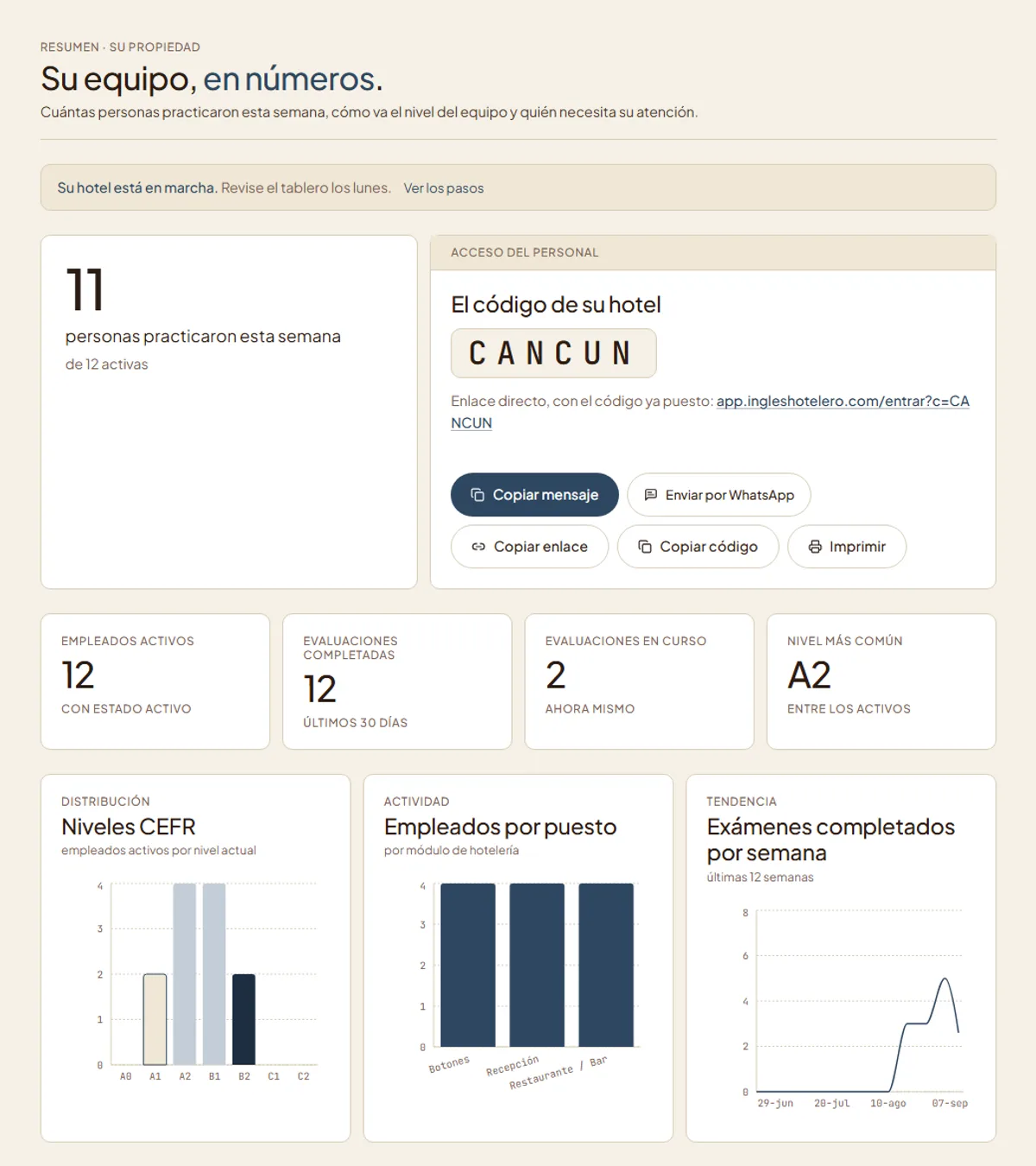
Level, progress and streaks by employee and by property. The number your monthly report was missing.
About training your team in Fort Lauderdale.
Cruise season is our crunch. Can we train before it rather than during?
That is the better pattern. Run the free placement test in the shoulder season, start daily practice then, and arrive at your peak with a team that has been practicing for weeks. There is also a seasonal pause if a property genuinely closes down.
Some of our staff speak Haitian Creole, not Spanish. Does that work?
Honestly, not as well. The instruction and coaching are in Spanish, which is what makes it land for Spanish-speaking employees. Creole-speaking staff can use it, but they would be learning through a second language rather than their first. We would rather tell you that up front.
What does it cost for a single beachfront property?
Pricing is per property by headcount band, starting at $150 USD a month, and it does not change when your headcount moves within a band. The placement test is free before any of that starts.
Put your Fort Lauderdale team to work in English.
Free placement test for the whole property, no obligation. We reply within one business day.
Request a demo